
Attic fans
How does an attic fan work
The short answer
How does an attic fan work? A powered fan exhausts air from a vented attic.
Last updated October 2026
What's covered11
- How does an attic fan work in a vented roof?
- The ceiling boundary matters
- How does an attic fan work with a thermostat?
- Why the fan may cycle or remain off
- Attic exhaust versus whole-house cooling
- What passive ventilation does differently
- Check the system, rather than just the motor
- Follow one air parcel through the system
- Before changing an existing system
- FAQ
- Verdict
How does an attic fan work? A powered fan exhausts air from a vented attic. Planned intake openings supply outdoor replacement air.
It does not normally pull room air through open windows like a whole-house fan. If the ceiling leaks, though, it can draw room air unintentionally. That is a building problem, not useful cooling.
Follow the intended air route: outdoor intake, vented attic and exhaust outlet. Check the exact fan's intake requirements and controls. Do not assume attic heat removal equals room cooling or lower bills. Ceiling leakage can change where replacement air comes from. A passive roof system or a different assembly may be more suitable.
How does an attic fan work in a vented roof?
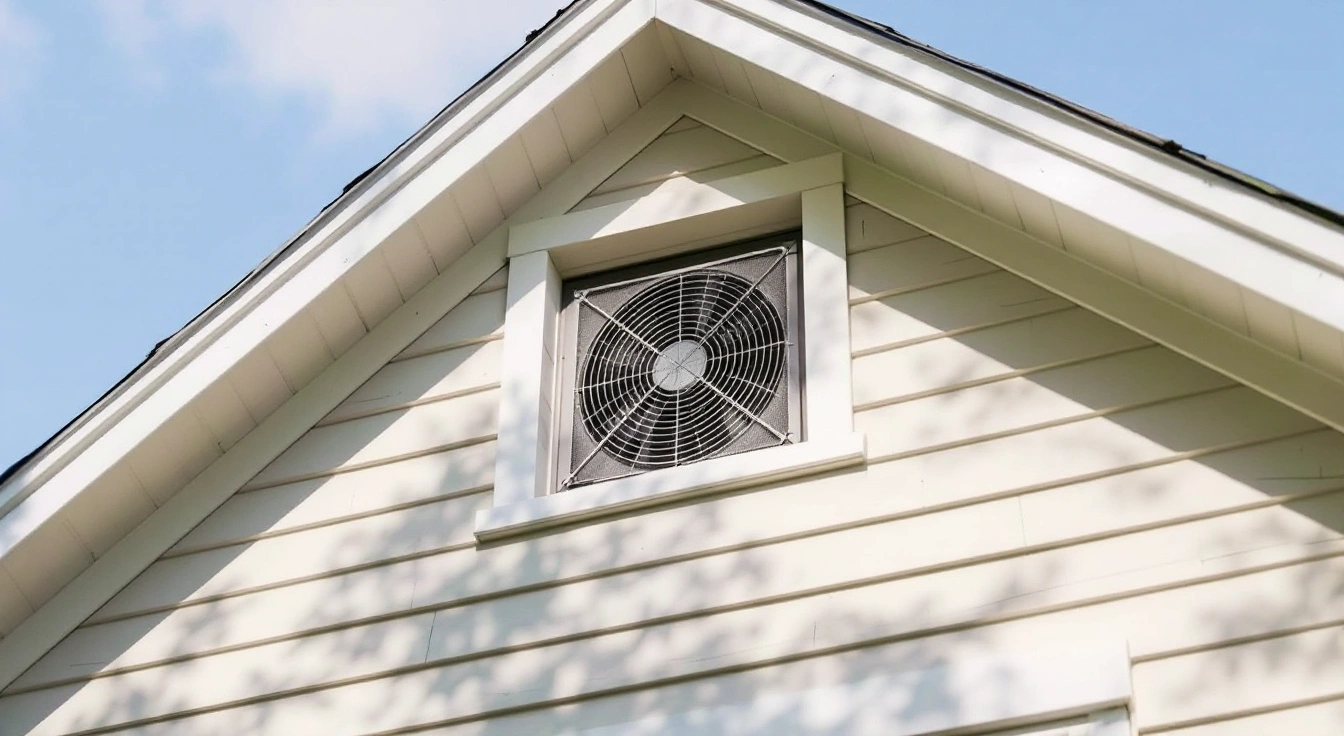
The motor turns a blade that creates an exhaust flow. On a roof-mounted unit, the air leaves through a roof opening. On a gable-mounted unit, it leaves through a compatible wall opening. Each design needs the right mounting and weather detail. A roof flange and a wall louver are different parts.
As air leaves, other air must replace it. The intended source is outdoors through the designed intake. Low intake often lies at the eaves, with a clear channel beyond the insulation. The fan cannot create that opening by itself. If a route is blocked, the replacement air may follow an unintended path.
The attic ventilation guide explains the whole roof arrangement. A fan is only one part of it. The exact unit instructions should state its replacement-air needs. A generic passive area ratio is not a substitute for that requirement.
The ceiling boundary matters
PNNL's attic-fan guidance describes how powered exhaust can draw treated room air through ceiling leaks. The motor may be operating normally while the air route is wrong. A cooler attic reading does not reveal how much room air was lost through the ceiling.
Common boundary questions include the attic hatch and openings around services. Insulation alone does not prove those paths are sealed. A home's air barrier must be reviewed separately. Do not cover electrical equipment or combustion clearances with improvised foam to solve the problem.
A fan may draw air from the occupied space. If so, air elsewhere must replace that room air too. That can change house pressure.
Fuel-burning equipment that depends on indoor air needs particular care. Have the building and appliance layout checked. Do not assume the roof fan is harmless.
Our safety guide describes the stop conditions. An unexplained combustion smell or a carbon monoxide alarm is not an airflow experiment. Follow emergency guidance and do not restart the fan to test a theory.
How does an attic fan work with a thermostat?
A temperature control can call for operation when its sensor reaches the selected threshold. The behavior depends on the exact controller. Some controls switch one run mode.
Others select more than one speed. The control does not measure ceiling air leaks. It does not check whether outdoor intake is sufficient either.
Sensor position matters. A reading at one point does not describe every roof bay. A sensor may sit near an unusual heat source.
It can then behave differently from one at the intended mounting point. The instructions determine the correct arrangement. Do not move the sensor from a remote guess about attic temperature.
Humidity controls add another signal. Their interaction with temperature logic is model-specific. They may not behave like a simple thermostat.
The control guide explains what to verify before changing a controller. Check the exact guide for app features. Never assume it offers internet control or remote safety monitoring.
Why the fan may cycle or remain off
An off fan may be below the temperature threshold. It may have no supply power. A controller could also be in another mode. Those possibilities cannot be distinguished by looking at a motionless blade from outside. Record the model and observed condition for a technician.
A fan may cycle because its sensor crosses the control threshold. That is different from a motor that tries to start and stops. A fault can involve the motor or its control. Use safe isolation and the exact guide for diagnosis. Do not keep restarting the unit.
Solar-powered attic units depend on their panel and control arrangement. A cloud can change available power. Some packages have another power option.
Others do not. Do not assume a solar label means night operation. The particular package determines that behavior.
Attic exhaust versus whole-house cooling
A whole-house fan moves room air on purpose. It draws new air through planned room openings. Many conventional systems then discharge through a vented attic. Its room-air task differs from an attic exhaust fan. The two should not be selected solely by matching their CFM labels.
Our whole-house definition describes that route. The room airflow calculator estimates a named planning method for that task. Neither page supplies the intake sizing rule for an unrelated powered attic fan.
Nor should an attic fan be expected to cool a room as AC does. It does not provide refrigeration or moisture removal from indoor air. Any home-energy benefit depends on the real roof and leakage. PNNL's warnings are why this guide does not promise a bill reduction from a cooler attic reading.
What passive ventilation does differently
A passive system has no powered exhaust motor. Its flow depends on the roof arrangement and conditions. It still needs suitable intake and high outlets. The distribution and usable area must match the vented assembly. No motor does not mean no design work.
Passive ventilation can be the relevant starting point before adding powered exhaust. Air sealing and insulation may address a different cause of discomfort or moisture. A fan purchase should follow that diagnosis. It should not be used to avoid checking the roof.
Check the system, rather than just the motor
| Observation | What it can show | What it does not prove |
|---|---|---|
| Blade turns | Motor is moving the blade | Safe or sufficient replacement air |
| Attic feels cooler | Conditions changed at that place | Whole-home energy savings |
| Controller switches on | One control condition was met | Correct sensor placement or safe pressure |
| Eave vents are visible | Exterior openings exist | Clear channels behind insulation |
| Fan is quiet | No obvious noise at that moment | Correct mounting or electrical condition |
Scroll for more →
Keep the exact model and controller guide with the house records. Record intake facts and any installation changes. Use the installation planning guide before adding or moving equipment. For an existing fault, use repair planning instead of buying from the symptom alone.
Follow one air parcel through the system
Imagine outdoor air entering a clear low intake. It passes the eave insulation along the intended channel. It reaches the connected attic space. The fan then moves attic air through its planned roof or wall outlet. This is a conceptual route, not a measured flow claim.
Now imagine the low path is blocked. The motor can still try to exhaust air. Replacement air must come from somewhere else. A nearby high outlet or a ceiling leak may become part of the route. The fan's operation has not established that the planned low intake works.
That comparison explains why a motor check and a building check are separate. The first confirms a mechanical response under the service process. The second establishes the intended path and boundary. A complete assessment should name which checks were included.
Before changing an existing system
Keep the old model and roof plan if they are known. Note any recent roof or insulation work. The fan may be unchanged while its surrounding route has changed. That context can help an installer diagnose why operation now differs.
Do not add another motor just to obtain more movement. Define the required task first. If the issue is wet material, identify the source. If the issue is a failed start, use service. A precise equipment capacity cannot answer an unclear building problem.
FAQ
Does an attic fan take hot air out of rooms?
Its intended job is to exhaust air from a vented attic. Room-air exchange is the job of a whole-house system. If an attic fan pulls room air through ceiling leaks, that is an unintended route. Have the boundary and replacement-air path checked rather than counting it as useful room cooling.
Does it need open windows downstairs?
Do not use downstairs windows as a substitute for an attic fan's intended outdoor intake. The roof exhaust plan should obtain replacement air through the roof system. Whole-house fans have a different window-intake task. Identify which fan you own and use its exact instructions before changing the operating plan.
Is a cooler attic proof of savings?
No. The reading does not show where replacement air came from or how the house's cooling load changed. Room-air leakage can offset a supposed benefit. Keep measured attic conditions separate from verified household energy performance. A bill reduction or payback needs evidence beyond a heat change.
Why is mine not running on a hot day?
The exact control setting and sensor reading matter. Supply power or a fault may also be involved. Solar packages have their own power conditions. Record the model and symptom without reaching near the blade. Use a technician for power diagnosis rather than bypassing the controller to force operation.
Keep the named method with each estimate. A room-air target and a passive vent total cannot be used as the powered fan's own intake rule.
Verdict
The useful answer to how does an attic fan work is an air-path explanation. Its motor exhausts attic air, while planned outdoor intake supplies replacement air. Check that route and the ceiling boundary before trusting a heat change. A working fan does not certify room cooling or energy savings.
Return to the best attic fan guide.