
Whole house fans
Belt drive whole house fan
The short answer
A belt drive whole house fan uses a belt to transfer motion from its motor to the fan shaft. It is a room-cooling system, not merely an attic exhaust fan.
Last updated October 2026
What's covered9
A belt drive whole house fan uses a belt to transfer motion from its motor to the fan shaft. It is a room-cooling system, not merely an attic exhaust fan. Compare the complete mounting, guard and closure design before choosing it. The belt layout can suit a conventional installation, but it does not prove lower noise or lower bills.
Identify the exact fan and manual before any service. A belt and its moving parts need the required guards. Keep power isolated for permitted work and do not run with a guard removed. Compare conventional mounting with ducted and insulated alternatives. All still need safe window intake, suitable outdoor air and a checked outlet.
How a belt drive whole house fan works
The motor turns a pulley. A belt carries that motion to another pulley on the fan shaft. The blade moves room air toward the discharge path. The motor and blade are linked by the belt instead of sharing a direct shaft connection. That mechanical distinction does not change where the room-cooling air needs to come from.
The home still needs the planned open windows before operation. Air crosses the served rooms toward the inlet. Many conventional units discharge into a vented attic. The outlet must allow that air to leave outdoors. The belt cannot overcome closed intake or insufficient outlet area.
GAF's manufacturer brochure for conventional whole-house fans (PDF) identifies the 30BWHFS belt-drive example discussed in this guide. It describes a two-speed wall-switch arrangement and ceiling shutters. Those are exact source facts, not permission to apply its service method to another old fan.
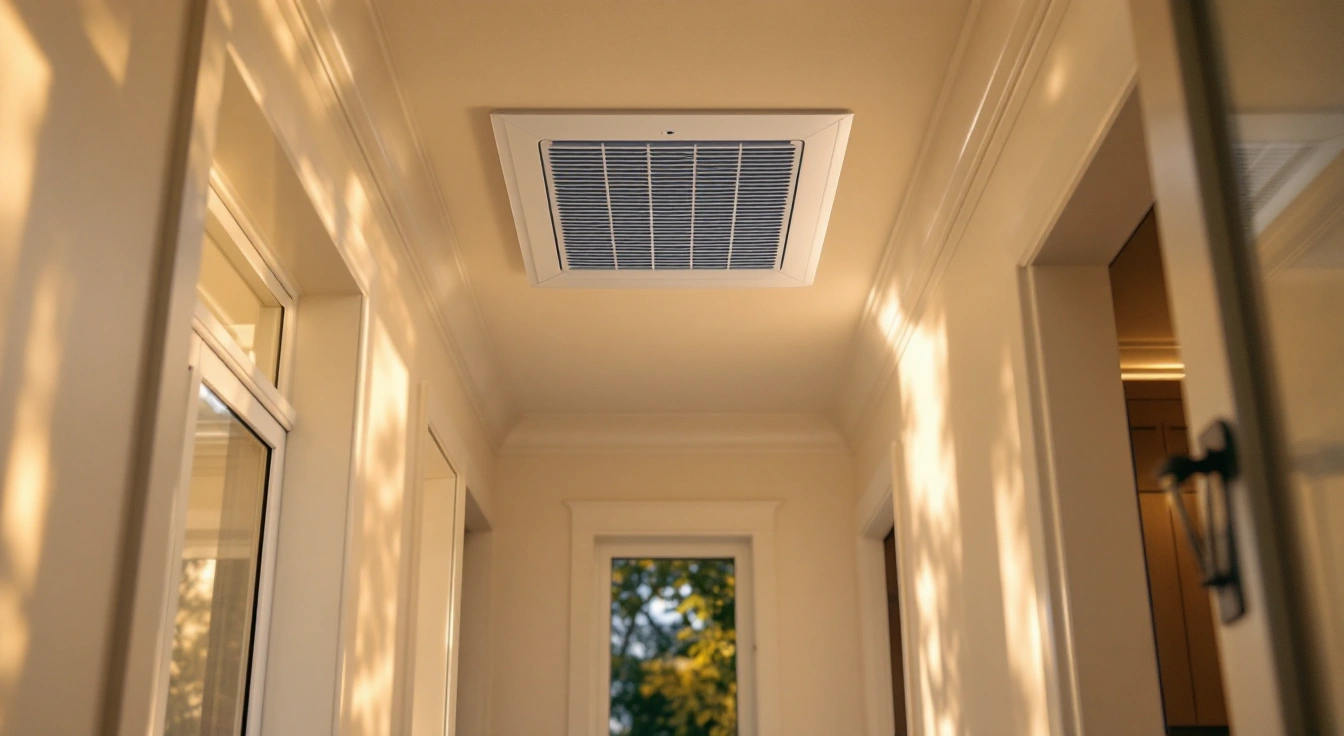
The fan housing and support carry the assembly. The guard limits access to moving parts. The ceiling shutter opens for airflow and closes when it is not running as designed. An off-season cover may be a separate item. Keep these functions distinct rather than calling all of them “the belt fan.”
Belt drive whole house fan versus direct drive
Direct drive puts the blade and motor on a common shaft arrangement. Belt drive uses separate motor and fan pulleys. Both can work only within the complete fan's intended design. A replacement motor with a similar power label is not automatically compatible. Mounting and operating speed must match the approved part.
| Decision | Belt drive | Direct drive |
|---|---|---|
| Motion transfer | Belt between motor and fan pulleys | Motor directly drives the blade arrangement |
| Service evidence | Exact belt and pulley requirements | Exact motor and blade requirements |
| Guard needs | Moving belt and blade protected as specified | Moving blade and motor protected as specified |
| Sound conclusion | Depends on the complete fan and mount | Depends on the complete fan and mount |
| Cooling suitability | Intake, outlet and outdoor air still required | Same building and use checks apply |
Scroll for more →
Do not infer a sound ranking from the drive type. Belt movement can create its own sound or vibration. Direct-drive equipment can use different motor speeds and blade designs. A matched comparison needs the same airflow duty and a stated test method. A general claim that all belt fans are quiet is not supported here.
A change in drive design can also change service access. A motor positioned beside the blade may be reached differently from one inside a ducted assembly. That is useful to discuss before purchase. It is not a reason to perform live adjustments or remove guards for convenience.
An old fan may have had non-original parts fitted. Record that history before using its model label to order another belt or motor. The complete assembly might no longer match the original guide. The repair scope should confirm what is actually installed and which approved parts restore that design.
Mounting and sound considerations
Conventional ceiling layouts can need framing work. Do not cut a ceiling joist to make a grille fit without the proper structural design. The visible opening is not the whole mounting requirement. The fan's weight and vibration must be carried by the support specified in its guide.
A loose mount can transmit sound to rooms below. A shutter can rattle in wind while the fan is off. An inlet restriction can add air noise during use. These events have different causes. A belt adjustment is not a general cure for every sound coming from the ceiling.
Record the noise from a safe place. State whether it occurs at startup, at one speed, or while off in wind. Do not reach through the grille to press on a moving shutter. Do not hold a fan housing steady while it runs. The observation should not put you in contact with moving or electrical parts.
PNNL's whole-house guide describes other layouts, including separated ducted motors. Compare those if the conventional arrangement is unsuitable. A sound concern can be a reason to review layout, but a ducted option still needs room for its approved route.
Maintenance and guards
Follow the exact guide for belt inspection or adjustment. There is no universal tension setting in this article. A belt that seems loose can have a different correct method from another model. Too much or too little tension can affect the assembly. Use the manufacturer's specified procedure and matched parts.
Do not put hands or tools near a connected belt. A timer or remote can start the fan unexpectedly. “Off” at a control is not proof of isolation. Keep every supply route accounted for before any permitted work. The guide should describe the safe isolation and reassembly steps.
Never operate the unit with a required guard removed. A visible belt is not an inspection opportunity while it moves. Keep loose clothes and stored objects away from the assembly. A service record should show that guards and covers were restored before normal use resumed.
Motor lubrication also depends on the exact design. Do not add oil because another fan manual recommends it. Some motors are permanently lubricated. An old unit may have different parts from the original design. A matched service guide is more useful than a generic seasonal checklist.
Our maintenance page keeps routine care separate from repair. It also explains why the seasonal cover and outlet path need review after roof or insulation work. A belt can be in good condition while the air route has become unsuitable.
Sizing and intake checks
Use a named room-cooling airflow method before selecting capacity. Our whole-house fan calculator takes total served area and actual ceiling height. It displays a target or range with source limits. It does not turn that number into a guaranteed product recommendation.
Compare the result with the exact fan's rating basis. A headline CFM figure is not automatically its HVI rating. A brochure may contain no matched sound measurement. Leave those differences visible. Do not choose a larger blade because the old unit seemed weak before the air path is checked.
Window intake needs to be practical. A window that cannot remain open safely is not available for the operating plan. Count its usable opening, not the entire frame. Keep the path through rooms clear in the approved way. Do not use garage air as a substitute for outdoor room intake.
The attic outlet needs documented free area and a clear route. Screens and louvers reduce the opening compared with its face dimensions. Use a known NFA rating. Then check that insulation or roof alterations do not block the route. A correctly sized vent label does not prove the path behind it is open.
Fuel-burning equipment must be assessed before the fan is used. Strong room exhaust can affect pressure when intake is inadequate. Outdoor smoke and moisture can also make use unsuitable. These issues are not belt-drive defects and cannot be solved by another pulley or higher speed.
Seasonal closure and operating plan
A conventional shutter may close the inlet without providing an insulated seal. Compare the exact closure and any permitted seasonal cover. Thermal resistance and leakage are separate facts. A thick cover should not be treated as proof of an airtight ceiling boundary. Its perimeter and fit matter too.
Remove a removable cover before operation as directed. Keep the fan out of use while the cover blocks the path. A stored cover can be forgotten when a timer or remote is used. Make the seasonal state clear for other household members. Automatic shutters do not override a second cover left in place.
Use the fan when outdoor air fits the room-cooling task. A belt mechanism does not cool or dry incoming air like an air conditioner. Do not run both systems as though they were interchangeable. Our fan versus AC comparison explains the outdoor-air and humidity distinction.
If a fan is being replaced, compare the complete installation scope. A new layout can need a different opening or discharge plan. Reusing an old switch or guard requires exact compatibility. Our installation guide explains those checks before selection.
Choose a suitable whole-house layout
The main whole-house fan comparison compares QuietCool CL-3100 RF, Tamarack HV1600R38 and QuietCool ES-4700 RF. Those are ducted and insulated-door options, not a belt-drive shortlist. The 30BWHFS brochure supports the belt-drive discussion here; it does not establish current stock or a place in that comparison. Use the actual supplied model and guide for a purchase decision.
For an existing fault, use the service and upkeep guide before buying a new assembly. A failed belt or motor may have a matched repair route. A mount or air-path fault can remain after replacement. Compare diagnosis and full scope, not just a part price.
Keep the mechanical and building records together
If the belt or motor is changed, keep its approved part number. Record which guide governed the work. The next service visit should be able to see that history. A new belt should not hide an unresolved mount fault. Keep any earlier noise record with it.
Keep the roof and vent records too. A later roof job can change the available outlet. Insulation work can restrict a passage behind a vent. Tell the installer which fan uses that path. Check the route again before the next season of use.
For daily operation, keep the normal settings clear. Note which mode was planned for the available windows. Do not assume a control change leaves that plan unchanged. The fan needs the same suitable outdoor-air checks as other whole-house systems. The drive mechanism cannot make bad outdoor conditions fit.
FAQ
Is belt drive always quieter?
No matched evidence supports that general claim here. Drive type is one design fact, while blade speed and mounting also affect sound. A fair comparison needs the same airflow duty and test basis. A loose belt or mount can add noise to a model that otherwise operates normally.
Can I use any belt of the same length?
Use the approved part and service method for the exact assembly. Length alone does not establish the correct belt profile or operating fit. Past motor or pulley changes may also affect compatibility. Keep the model and service history with the part reference before ordering.
Should the fan run while I adjust tension?
Do not adjust a moving or connected belt. Follow the guide's isolation procedure and restore required guards before operation. A timer or control can start the fan unexpectedly. The purpose of an inspection is to identify the condition safely, not to touch it under load.
Does a larger blade mean better cooling?
Not without a suitable air path and target. More flow can require more window intake and attic outlet area. It can also affect sound and mounting. Check the exact rating basis and installation guide. The blade diameter does not assess outdoor conditions or combustion safety.
Where can I compare insulated alternatives?
Our closure and installation planning compare closure designs separately from capacity and sound. An insulation label is not proof of airtightness. Use that comparison when off-season heat transfer matters, then confirm the exact opening and control needs for the selected model.
Verdict
A belt drive whole house fan is a specific mechanical layout with model-specific care. Choose it only when the complete mounting and air path fit. Keep guards and isolation requirements central to service, and compare other layouts without assuming the drive type settles noise or savings.